
When a note comes home from school saying your child did not pass the vision screening, it is natural to feel a wave of worry. Many parents wonder what they missed, whether something is seriously wrong, or how quickly they need to act. The good news is that a failed screening is simply a signal to take a closer look, and most of the issues it uncovers are common and very treatable. At Pediatric Eye Specialists, we help North Texas families take this next step every school year, and we want you to know exactly what to expect.
What Does It Mean When My Child Fails a School Vision Screening?
A school vision screening is a quick check designed to identify children who may need further care. In most cases, a school nurse or trained staff member asks each child to read letters or shapes from an eye chart placed at a set distance. This measures visual acuity, or how sharply your child can see, and sometimes includes a brief check of eye alignment. If your child cannot read enough of the chart with one or both eyes, the screening is marked as a fail and a referral letter is sent home.
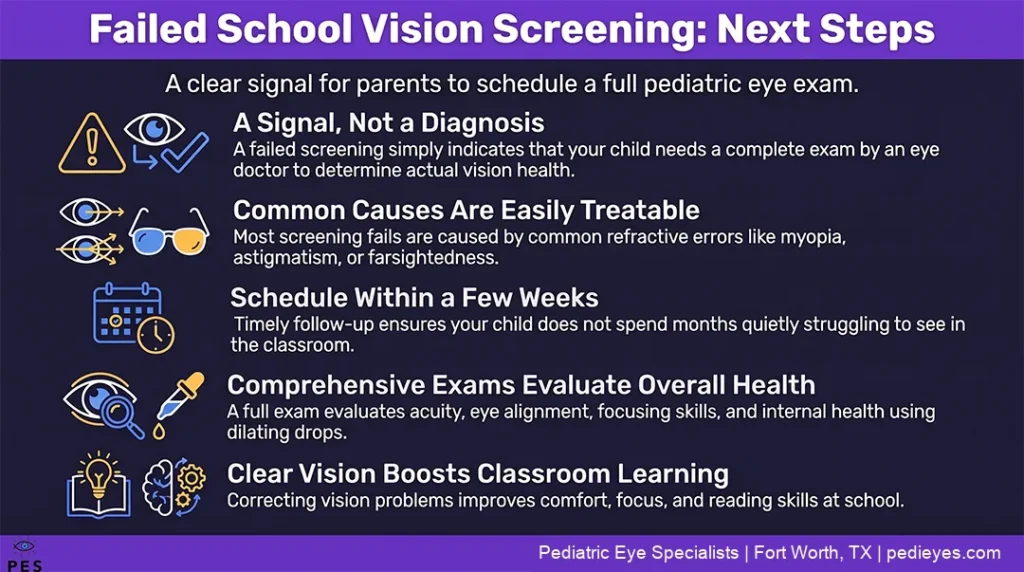
A failed screening is not a diagnosis. It tells you that your child’s eyes did not meet the cutoff on that particular day and that an eye doctor should take a closer look. Some children who do not pass turn out to have healthy eyes and clear vision once they receive a full exam. Others have a vision problem that was quietly making school harder for them. Either way, the screening has done its job by giving you the information you need to take action.
At Pediatric Eye Specialists, we regularly see children who arrive with a school referral letter in hand. We understand that this is often a family’s first experience with an eye doctor, and we work to make the visit comfortable for you both.
Why Might My Child Have Failed the Vision Screening?
The most common reason children fail a school screening is a refractive error, which means the eye does not focus light properly. Myopia, also called near-sightedness, is especially common in school-age children. A child with myopia sees nearby objects clearly but has trouble with things at a distance, such as the whiteboard or the chart across the room. Astigmatism, which occurs when the front of the eye is shaped more like a football than a basketball, can blur vision at every distance. Farsightedness can also cause difficulty, particularly with reading and other close work.
Less often, a failed screening points to amblyopia (lazy eye) or strabismus, a condition in which the eyes are not properly aligned. Both respond best to treatment when they are caught early, which is one of the main reasons timely follow-up matters.
Sometimes the cause has little to do with the eyes at all. A child may have been nervous, distracted by a busy hallway, unsure of certain letters, or simply tired that day. A comprehensive eye examination helps sort out what is really going on.
How Soon Should I Schedule an Eye Exam After a Failed Screening?
We recommend scheduling a comprehensive eye exam within a few weeks of receiving the referral letter. A failed screening is rarely an emergency, but waiting several months can mean your child spends a large part of the school year struggling to see clearly. Children also rarely complain about blurry vision because they assume everyone sees the way they do.
When you call to schedule, have the screening form nearby so you can share what the school reported. If you have noticed your child squinting, sitting close to the television, rubbing their eyes, or complaining of headaches, be sure to mention those details as well.
What Happens During My Child’s Follow-Up Eye Exam?
A comprehensive pediatric eye exam goes well beyond the chart your child read at school. Our doctors use age-appropriate testing to measure visual acuity in each eye, check how well the eyes work together, and evaluate how the eyes focus at near and far distances. In most cases, we use dilating drops so we can examine the health of the retina and optic nerve and determine your child’s true prescription. Dilation can leave vision a little blurry and sensitive to light for several hours, so a pair of sunglasses and a relaxed afternoon are helpful.
Because our practice is dedicated entirely to pediatrics, every part of the visit is designed with children in mind. Our therapeutic optometrists, Dr. Alicia Derry, Dr. Emily Horn, and Dr. Trey Paschal, bring years of experience in pediatric optometry and know how to keep young patients relaxed and engaged. If the exam reveals a medical concern, our fellowship-trained pediatric ophthalmologists are available within the same practice, so your child can move from optometry to pediatric ophthalmology care without an outside referral.
Start your child’s journey to better vision today.
Embrace a future of clearer vision and confidence for your child. Contact us now to book your consultation at any of our convenient locations across the Metroplex.
What If My Child Needs Glasses?
If your child is diagnosed with myopia, astigmatism, or another refractive error, glasses are usually the simplest and most effective solution. Most children adjust quickly and notice right away that leaves on trees, faces across the room, and words on the board look sharper than they ever realized.
Pediatric Eye Specialists has an in-house optical shop, so families can choose durable, kid-friendly frames right after the exam and have them fitted properly for a growing face. For children whose near-sightedness is progressing, our doctors can also discuss myopia management options and recommend how often your child’s prescription should be rechecked.
How Can I Talk to My Child About Their Screening Results?
Children pick up on their parents’ feelings, so a calm and positive approach goes a long way. A simple explanation, such as “The school wants a special eye doctor to check how your eyes are working,” is usually enough. You can let your child know that the visit does not involve shots and that the doctor will mostly ask them to look at pictures, letters, and lights. For more ideas, our guide to preparing your anxious child for their first eye appointment offers practical tips.
If your child does need glasses, present it as an exciting change and let them help choose their frames. In many ways, good parenting through this experience is less about having every answer and more about showing your child that caring for their eyes is a normal, healthy part of growing up.
Can Vision Problems Affect My Child’s Learning at School?
Yes. A large share of classroom learning is visual, from reading and copying notes to following math problems on the board. A child who cannot see clearly may lose focus, avoid reading, or seem uninterested, and these behaviors are sometimes mistaken for attention problems. Visual perception, which is how the brain interprets what the eyes see, also plays an important role in reading and writing skills. You can learn more in our article on vision-related learning problems.
Correcting a vision problem often leads to noticeable improvements in comfort, confidence, and schoolwork. Once you have a diagnosis, consider sharing it with your child’s teacher so they can offer support, such as seating your child closer to the front of the classroom while they adjust to new glasses.
Key Takeaways for Parents
- A failed school vision screening is a reason for a closer look, not a diagnosis.
- Myopia, astigmatism, and other refractive errors are the most common reasons children do not pass.
- Schedule a comprehensive eye exam within a few weeks so vision problems do not hold back learning.
- A full exam checks eye health, focusing, and alignment, not just how well your child reads a chart.
- Glasses are often a simple fix, and most children adjust quickly.
Ready to Schedule Your Child’s Eye Exam?
If your child recently failed a school vision screening, Pediatric Eye Specialists is here to help you find answers. Our compassionate team of pediatric optometrists and fellowship-trained pediatric ophthalmologists offers advanced eye care for every child, all under one roof. Book your child’s appointment at our Fort Worth, Keller, Mansfield, or Prosper office, or call us at 817-529-9949 to take the next step toward clearer vision and a more confident school year.
Medically Reviewed By:
Alan A. Norman, MD
Board-Certified Ophthalmologist
Fellowship-Trained Pediatric Ophthalmology and Adult Strabismus
Last reviewed October 13, 2026
David F. Skanchy, MD is a board-certified ophthalmologist and fellowship-trained pediatric ophthalmologist and adult strabismus specialist at Pediatric Eye Specialists. He completed his residency and pediatric ophthalmology/adult strabismus fellowship at the Kellogg Eye Center at the University of Michigan, where he served as chief resident. A member of the American Academy of Ophthalmology and AAPOS, he treats the full range of pediatric eye conditions and specializes in complex strabismus, amblyopia, pediatric cataracts, and retinopathy of prematurity.