
If your child’s eye doctor has recommended patching for lazy eye, you may be feeling a mix of relief and uncertainty. It is reassuring to have a clear treatment plan, but many parents quickly wonder how they will keep a patch on a busy toddler or convince a school-age child to wear one every day. The good news is that patching is one of the most proven treatments in pediatric ophthalmology, and a few simple strategies can make it much easier at home. At Pediatric Eye Specialists, we guide North Texas families through this process every day, and we are here to support you along the way.
How Does Eye Patching Treat Amblyopia?
Amblyopia, commonly called lazy eye, happens when the brain favors one eye over the other during early childhood. Over time, the brain learns to rely on the stronger eye and pays less attention to the signals coming from the weaker one. As a result, the weaker eye does not develop normal visual acuity, even when the eye itself looks healthy.
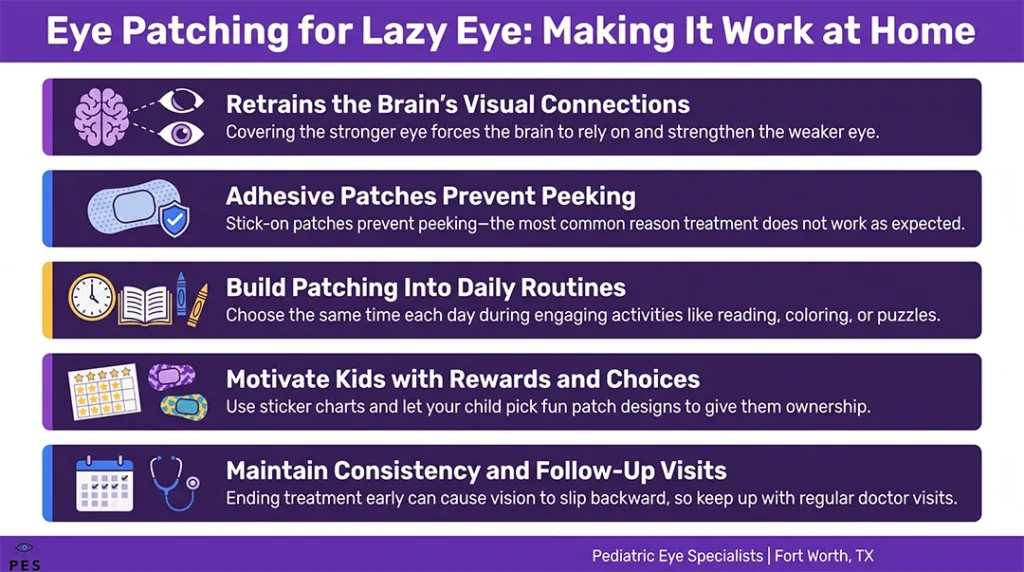
An eyepatch covers the stronger eye so the brain has no choice but to use the weaker eye. With regular practice, the connection between the weaker eye and the brain grows stronger, and vision in that eye improves. Patching does not change the shape of the eye. Instead, it retrains how the brain processes what the eye sees, which also supports healthy visual perception and may help depth perception.
Amblyopia can develop for several reasons. Common causes include strabismus, a condition in which the eyes are not properly aligned, and a large difference in prescription between the two eyes, often from farsightedness or astigmatism. Less often, something blocking vision, such as a cataract or droopy eyelid, is the cause. You can learn more about these causes on our amblyopia (lazy eye) page.
How Long Will My Child Need to Wear a Patch?
Every treatment plan is different. Your child’s doctor will recommend a schedule based on your child’s age, the cause of their amblyopia, and how much the vision in the weaker eye is reduced. Some children patch for a short time each day, while others need longer sessions. Treatment usually continues for several months, with regular follow-up visits to measure progress and adjust the plan as needed.
Research has shown that patching works best when it starts early, while the visual system is still developing. However, studies have also found that many older children can still benefit from treatment. If your child is older, do not assume it is too late to see meaningful improvement.
If your child also needs glasses, they will usually wear them full time along with the patch. For some children, glasses alone improve vision before patching even begins.
What Type of Patch Works Best?
Most children use an adhesive patch that sticks directly to the skin around the eye. Adhesive patches are effective because they prevent peeking, which is one of the most common reasons treatment does not work as well as expected. Many brands come in fun colors and designs that children enjoy choosing.
For children who wear glasses, cloth patches that slip over the lens are another option. Your doctor will let you know whether this type is appropriate for your child, since some children can see around the edges of a cloth patch.
If your child develops redness or irritation from an adhesive patch, try the following:
- Change the placement slightly each day.
- Remove the patch slowly after a warm bath or with a little baby oil.
- Ask our team about patches made for sensitive skin.
How Can I Help My Child Wear a Patch Without a Struggle?
Consistency is the key to success, and a calm, positive approach goes a long way. These strategies have helped many of the families we work with.
Build patching into a daily routine. Choosing the same time each day, such as after breakfast or during an afternoon activity, helps patching feel like a normal part of the day rather than a battle.
Keep your child busy with activities they enjoy. Coloring, puzzles, building blocks, crafts, reading together, or a favorite show can make the time pass quickly. Engaging activities also give the weaker eye plenty of practice and support learning while your child patches.
Use a reward chart. Many children love earning a sticker for each completed patching session, with a small reward after a full week.
Let your child take ownership. Allow them to pick out patch designs, decorate plain patches, or put a matching patch on a favorite stuffed animal or doll.
Stay calm and steady. If your child pulls off the patch, gently put it back on without frustration. Children often test limits in the first week or two, and most settle into the routine once they see it is not optional.
Share the plan with other caregivers. Make sure grandparents, babysitters, and teachers understand the plan so treatment stays consistent.
Because covering one eye reduces depth perception, it is best to avoid patching during activities like riding a bike or playing sports. Ask your child’s doctor which activities are safest during patching time.
Start your child’s journey to better vision today.
Embrace a future of clearer vision and confidence for your child. Contact us now to book your consultation at any of our convenient locations across the Metroplex.
What If My Infant or Toddler Needs Patching?
Patching an infant or toddler takes patience, but young children often adapt faster than parents expect. Try to patch during times when your child is awake, fed, and happy, and keep their hands busy with toys or snacks. Distraction is your best tool at this age. If your little one keeps removing the patch despite your best efforts, let our team know. We can share additional ideas or discuss whether another approach might be a better fit.
Are There Alternatives If Patching Is Not Working?
For some children, other treatments may be an option. Atropine eye drops can blur vision in the stronger eye so the weaker eye does more of the work. Newer digital treatments, which use specially designed programs or devices, may also be appropriate for select children. Your child’s doctor can explain whether any of these options make sense based on your child’s needs.
It is important not to stop patching on your own, even if you see improvement. Ending treatment too early can allow vision to slip backward. Regular follow-up visits let our doctors track your child’s results, adjust the schedule, and decide when it is safe to taper off.
Why Is Treating Amblyopia So Important?
Without treatment, amblyopia can lead to lasting visual impairment in the weaker eye. Treating it during childhood gives your child the best chance for strong, balanced vision for school, sports, and everyday life.
At Pediatric Eye Specialists, our practice is dedicated entirely to pediatrics. Our team includes fellowship-trained pediatric ophthalmologists and therapeutic optometrists with experience in amblyopia care, including involvement in amblyopia research. From diagnosis to follow-up, we partner with your family at every step.
Key Takeaways for Parents
- Patching helps the brain learn to use the weaker eye and is one of the most proven treatments for amblyopia.
- Your child’s doctor will recommend a schedule based on their age, diagnosis, and progress.
- Daily routines, fun activities, and reward charts make patching easier at home.
- Adhesive patches help prevent peeking, and gentle removal can protect sensitive skin.
- Keep up with follow-up visits and do not stop treatment without talking to your child’s doctor.
Ready to Talk With Our Team About Your Child’s Treatment?
If your child has been diagnosed with amblyopia or you have questions about patching, Pediatric Eye Specialists is here to help. Our team of pediatric ophthalmologists and optometrists offers advanced eye care for every child, all under one roof. Book your child’s appointment at our Fort Worth, Keller, Mansfield, or Prosper office, or call us at 817-529-9949 to give your child the best possible start toward clearer, stronger vision.
Medically Reviewed By:
David F. Skanchy, MD
Board-Certified Ophthalmologist
Fellowship-Trained Pediatric Ophthalmology and Adult Strabismus
Last reviewed October 19, 2026

Dr. Michael G. Hunt is a Partner at Pediatric Eye Specialists, Research Director at the Child Vision Center, and the Research and Education Director of Ophthalmology at Cook Children’s Medical Center. Dr. Hunt graduated Summa Cum Laude from Baylor University and received his medical doctorate with high honors from Baylor College of Medicine, where he was an Alpha Omega Alpha member and participated in medical missions.
Dr. Hunt completed his ophthalmology residency and fellowship in pediatric ophthalmology/adult strabismus at the University of Iowa Hospitals and Clinics. Since moving to Fort Worth in 2004, he has been recognized as a “Top Doc” by Fort Worth, Texas magazine. He is dedicated to medical mission work, including trips to Vietnam, and is a longtime volunteer at the Alexander Eye Clinic. Dr. Hunt has served as a primary investigator on several clinical trials and has published multiple peer-reviewed articles, demonstrating his commitment to advancing pediatric ophthalmology through research and education.