
Finding the right eye care for your child starts with understanding what routine pediatric exams should include and what qualifications matter most. The right practice makes eye exams comfortable for children while providing thorough evaluations that catch problems early.
What qualifications should I look for in a DFW pediatric eye doctor for routine exams?
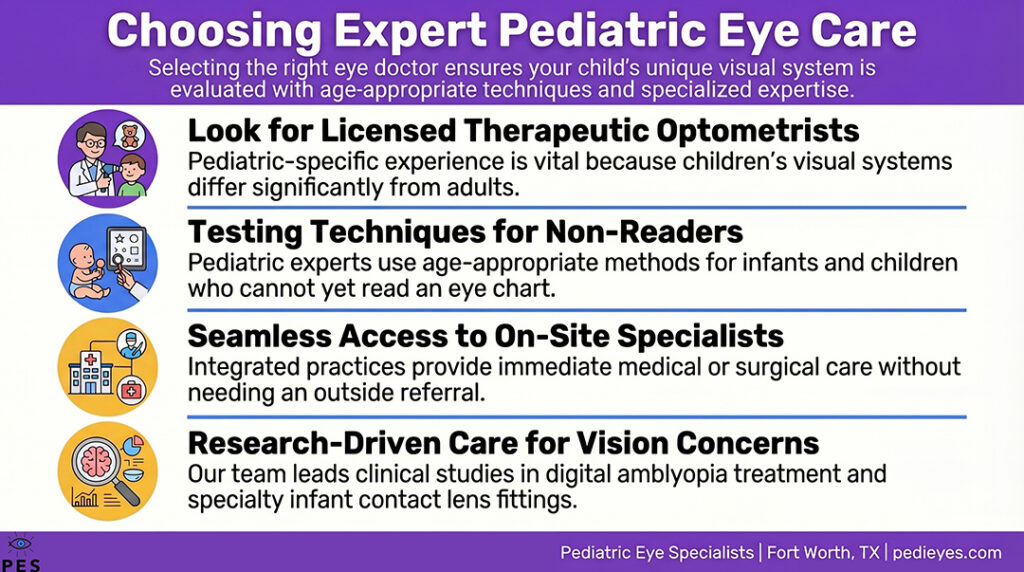
For routine pediatric eye exams in DFW, parents should look for a Doctor of Optometry (OD) with a therapeutic optometrist license and extensive experience working specifically with children. Pediatric optometrists are trained in age-appropriate testing techniques that work for older children and children who cannot yet read an eye chart. Years of pediatric-specific experience matters because children’s eyes and visual systems differ significantly from adults. Practices that also have pediatric ophthalmologists on-site provide an added layer of reassurance—if your child’s optometrist identifies a medical or surgical concern, specialist care is immediately available without an outside referral.
At Pediatric Eye Specialists, three therapeutic optometrists bring decades of combined pediatric experience: Dr. Robert (Trey) Paschal has over 16 years specializing in children’s eye care including specialty contact lens fitting for infants; Dr. Alicia Derry brings more than 20 years of experience along with involvement in clinical amblyopia research; and Dr. Emily Horn, with over 10 years of pediatric experience, serves as principal investigator for digital amblyopia treatment studies. If any of our optometrists identify a concern requiring medical intervention, fellowship-trained pediatric ophthalmologists are available at the same practice.
How does pediatric eye care work at a specialized practice in DFW?
At pediatric eye care practices in DFW, children typically see an optometrist for routine exams, glasses prescriptions, contact lens fittings, and ongoing vision monitoring throughout childhood. The optometrist serves as your child’s primary eye care provider for preventive and routine needs. If the optometrist identifies a medical condition such as amblyopia, strabismus, congenital cataracts, or other concerns requiring medical or surgical treatment, the child can see a pediatric ophthalmologist at the same practice—often within days rather than weeks. This integrated care model means no outside referrals, no transferring medical records to a new office, and no delays in getting your child the right level of care when it matters.
Pediatric Eye Specialists follows this integrated model across all four DFW locations. Routine exams are conducted by our therapeutic optometrists—Dr. Paschal, Dr. Derry, and Dr. Horn—who know when a child needs more than routine care. If escalation is appropriate, our fellowship-trained pediatric ophthalmologists—Dr. Packwood (Administrative Director of Ophthalmology at Cook Children’s), Dr. Norman (Medical Director of Ophthalmology at Cook Children’s), and Dr. Hunt (Research and Education Director of Ophthalmology at Cook Children’s)—provide consultations, medical treatment, and surgery at the same practice.
What should happen during a routine pediatric eye exam in DFW?
A routine pediatric eye exam in DFW should include visual acuity testing using age-appropriate methods, an eye alignment assessment to check for strabismus or tracking issues, refraction to determine whether glasses are needed, and an evaluation of overall eye health, including a dilated exam of the retina and optic nerve. Pediatric optometrists also screen for amblyopia, which is highly treatable when caught early but can cause permanent vision loss if missed. Routine exams typically take 45 to 60 minutes because pediatric optometrists use specialized techniques for children who cannot yet identify letters or verbalize what they see. Parents should expect a child-friendly approach—testing methods designed for kids, not simplified adult exams.
At Pediatric Eye Specialists, our optometrists conduct routine exams for children, toddlers through adolescents, using techniques developed specifically for pediatric patients. The child-friendly environment at each of our four DFW locations—Fort Worth, Keller, Mansfield, and Prosper—helps children feel comfortable during their exam. If anything concerning is identified during a routine visit, our optometrists can arrange an ophthalmologist consultation without delay, keeping your child’s care coordinated under one roof.
At what age should children in DFW have their first eye exam?
The American Academy of Ophthalmology recommends that children have their first comprehensive eye exam around age 3-4, or sooner, if screening by the primary care physician dictates. Many pediatric eye conditions have no symptoms parents would notice at home, which is why professional examination matters even when a child seems to see normally. Pediatric optometrists use objective testing methods that work for infants and preverbal children—your child does not need to know letters or speak to have a thorough exam.
Pediatric Eye Specialists sees children from birth through adolescence, and our optometrists are experienced with pediatric eye exams using age-appropriate techniques that don’t require verbal responses. Starting eye care early establishes a relationship with a practice that knows your child’s visual history. If a concern is ever identified—whether at six months or six years—our fellowship-trained ophthalmologists are on-site for immediate next steps.
How often do children in DFW need routine eye exams?
Children in DFW without known eye conditions should have routine eye exams if symptoms, medical risk factors or screening by the primary care physician dictate. Children who wear glasses often need more frequent visits—typically annually or as recommended by their optometrist—to ensure prescriptions remain accurate as their eyes develop and change. The pediatric optometrist will recommend an appropriate follow-up schedule based on each child’s specific visual needs, growth patterns, and any risk factors. Consistent routine care allows the optometrist to track changes over time and catch developing issues before they become significant problems.
Pediatric Eye Specialists provides ongoing routine care with individualized follow-up recommendations. With four DFW locations in Fort Worth, Keller, Mansfield, and Prosper, families can maintain regular appointments conveniently throughout their child’s development. Our optometrists monitor your child’s vision over the years, and if routine monitoring ever reveals a developing concern, ophthalmologist consultation is available at the same practice without changing providers or starting over.
How is a comprehensive pediatric eye exam different from a school vision screening in DFW?
Comprehensive pediatric eye exams conducted by optometrists evaluate eye health, alignment, focusing ability, depth perception, and near vision—detecting conditions like amblyopia, farsightedness, and subtle alignment issues that screenings routinely miss. A child who passes a school screening may still have significant vision problems affecting learning and development. School screenings serve as a basic check but are not a substitute for professional pediatric eye exams, particularly for children under age five who often do not participate in school screening programs at all.
Pediatric Eye Specialists’ optometrists provide the comprehensive evaluation that school screenings were never designed to deliver. Our exams assess all aspects of visual function and eye health, not just the distance vision measured by a school nurse with a wall chart. When thorough examination reveals a condition requiring medical treatment—whether amblyopia, strabismus, or something else—our fellowship-trained ophthalmologists are available at the same practice to provide the next level of care without delay.
Start your child’s journey to better vision today.
Embrace a future of clearer vision and confidence for your child. Contact us now to book your consultation at any of our convenient locations across the Metroplex.
What can a routine pediatric eye exam detect in DFW?
Routine pediatric eye exams in DFW can detect refractive errors including nearsightedness, farsightedness, and astigmatism that affect how clearly a child sees. Optometrists also identify amblyopia (lazy eye), eye alignment issues that may indicate strabismus, focusing problems, and early signs of conditions that benefit from medical attention. Many of these issues have no symptoms children or parents would notice—a child with vision in only one eye, for example, may function normally because they have never known anything different. Early detection during routine exams allows for timely intervention—amblyopia treatment, for example, is most effective when started early, ideally before age seven during the critical period of visual development, though newer research shows some children can benefit from treatment beyond this age.
At Pediatric Eye Specialists, our optometrists are trained to identify not only routine vision issues but also conditions that warrant ophthalmologist evaluation. If amblyopia, strabismus, or other medical conditions are detected during your child’s routine exam, a consultation with one of our fellowship-trained pediatric ophthalmologists can typically be arranged within days—not weeks. Early detection combined with immediate access to specialist care means better outcomes for children across DFW.
What questions should I ask when scheduling my child’s first eye exam in DFW?
Parents scheduling a first eye exam in DFW should ask five key questions: Does the practice specialize in children? What ages do they see? Are the optometrists experienced with young children and non-readers? What happens if the exam reveals a concern—is it referred out or handled in-house? What insurance is accepted? These questions help parents identify practices equipped for pediatric care at every level, from routine exams to conditions requiring medical intervention. Parents should feel confident that the practice can handle both preventive care and any concerns that might arise without requiring a separate search for specialty services.
Pediatric Eye Specialists answers these questions directly: we are a pediatric-only practice serving children from birth through adolescence. Our leadership includes Dr. Packwood, who has been recognized more than thirty times as a ‘Super Doctor’ by Texas Monthly, ‘Best Doctor for Your Child’ by D Magazine, and ‘Top Doc’ by Fort Worth, Texas magazine. Our therapeutic optometrists—Dr. Paschal, Dr. Derry, and Dr. Horn—have 10 to 20-plus years of pediatric experience each and are skilled at examining infants and non-verbal children. If a routine exam reveals a condition requiring medical or surgical care, our fellowship-trained ophthalmologists provide consultations and treatment at the same practice. Four child-friendly locations across DFW—Fort Worth, Keller, Mansfield, and Prosper—make scheduling convenient for families throughout the region.
Key Takeaways: Finding the Right Pediatric Eye Exam in DFW
Pediatric optometrists with therapeutic licenses and years of pediatric experience provide routine eye exams and vision correction for children throughout DFW.
Children should have their first comprehensive eye exam between six and twelve months of age, even without symptoms, with follow-ups at age three and before kindergarten.
Routine pediatric eye exams detect refractive errors, amblyopia, and alignment issues that school vision screenings in DFW typically miss.
The best pediatric eye practices in DFW have ophthalmologists on-site so children can receive medical or surgical care without outside referrals if a concern is identified.
Parents should ask whether optometrists specialize in children and what happens if the routine exam reveals a condition requiring further evaluation or treatment.
Ready to schedule your child’s eye exam? Pediatric Eye Specialists’ optometrists see children from birth through adolescence at four convenient DFW locations—Fort Worth, Keller, Mansfield, and Prosper. And if we ever find something that needs more than routine care, our fellowship-trained ophthalmologists are right here.

Dr. Eric A. Packwood is a Partner at Pediatric Eye Specialists, President of the Child Vision Center, and the Administrative Director of Ophthalmology at Cook Children’s Medical Center. He graduated from Rice University and Baylor College of Medicine, and completed his ophthalmology residency at St. Louis University as chief resident, followed by a fellowship at Washington University.
Since moving to Fort Worth in 2000, Dr. Packwood has been recognized as a “Super Doctor” by Texas Monthly, a “Best Doctor for Your Child” by D Magazine, and a “Top Doc” by Fort Worth, Texas magazine. He volunteers at the Alexander Eye Clinic and is involved in medical mission work for underprivileged children. Dr. Packwood has also published several peer-reviewed articles and participated in multiple clinical trials.