
Most parents feel reassured when their child passes a routine vision check at the pediatrician’s office, and that reassurance is well-placed. But many families aren’t sure how those routine checks fit into a broader schedule, or when a more thorough eye evaluation becomes necessary. Getting that timeline right matters. Early detection of eye and vision problems is one of the most consequential things you can do for your child’s development.
The following guide is based on the 2022 joint clinical statement from the American Academy of Ophthalmology (AAO) and the American Association for Pediatric Ophthalmology and Strabismus (AAPOS), the authoritative standard in pediatric eye care. At Pediatric Eye Specialists, these are the guidelines we follow for every child we see across North Texas.
Vision Screening vs. Comprehensive Eye Evaluation: An Important Distinction
Before walking through the schedule, it helps to understand what each type of assessment actually does, because the terms are not interchangeable.
A vision screening checks for red flags that may indicate a developing problem. Screenings are performed at pediatrician offices, schools, and community programs, and they play a critical role in catching issues early. They are not designed to fully evaluate the visual system.
A comprehensive eye evaluation by a pediatric ophthalmologist goes much further, assessing visual acuity, eye alignment, eye health, color vision, depth perception, and the presence of conditions like amblyopia, strabismus, astigmatism, farsightedness, or near-sightedness. According to the AAO/AAPOS, a comprehensive evaluation is specifically recommended when a child fails a screening or has identified risk factors, not as a routine step for every healthy, asymptomatic child.
Understanding this distinction is key to following the schedule correctly.
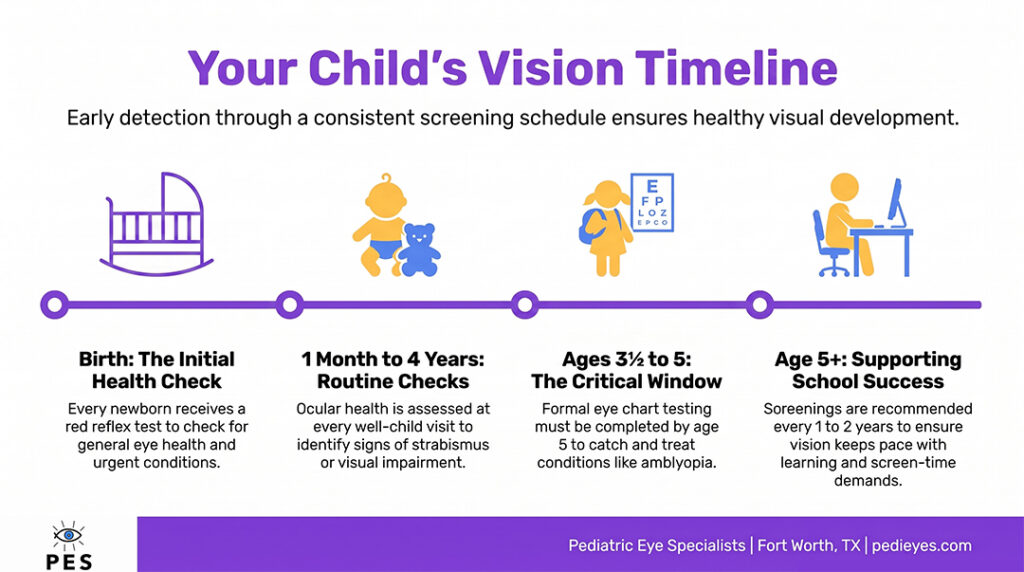
The Age-by-Age Eye Exam Schedule
Newborns
Eye health evaluation begins at birth. In the newborn nursery, a pediatrician, family physician, or other trained provider should examine the baby’s eyes for general health and perform a red reflex test. An abnormal red reflex requires urgent consultation with an ophthalmologist.
Certain newborns require an ophthalmologist’s evaluation from the start, including those at risk for retinopathy of prematurity, those with a family history of retinoblastoma, childhood glaucoma, or cataracts in childhood, those with a family history of retinal dystrophy or degeneration, those with systemic diseases or neurodevelopmental delays associated with eye problems, those with any opacity of the ocular media, and those with nystagmus.
Ages 1 Month to 4 Years
From 1 month through age 4, ocular health should be assessed at every routine well-child visit. This physical examination includes external inspection of the eye structures, pupillary examination, corneal light reflection testing, and evaluation of each eye’s fixation and following behavior. These checks are designed to identify visual impairment, signs of strabismus, and other developmental concerns as early as possible.
For children in the 12-month to 3-year window, photoscreening and handheld autorefraction may optionally be used to allow earlier detection of conditions that could lead to amblyopia. These instrument-based methods are particularly useful for toddlers who aren’t yet able to participate in chart-based visual acuity testing. A full ophthalmological examination is recommended for any child who does not pass these assessments.
Ages 3½ to 5 Years (Preschool)
This is the most critical window in pediatric visual development. According to the AAO/AAPOS, the ability to check visual acuity directly, using age-appropriate symbols and an eye chart, typically emerges between ages 3½ and 4 years. The guidelines are explicit that formal visual acuity testing should be completed by age 5. This is the clinical standard.
This window is when amblyopia and strabismus are most likely to be caught and most responsive to treatment. If untreated, amblyopia can cause irreversible visual loss. A child who is referred from a vision screening or who cannot cooperate at a second attempt should be referred for a comprehensive eye evaluation with a pediatric ophthalmologist or optometrist.
At Pediatric Eye Specialists, we frequently see children for their first thorough evaluation in this age window, and it’s where early intervention can make the most meaningful difference in a child’s vision for life.
Age 5 and Older (School Age Through High School)
Once a child enters school, vision is inextricably linked to learning. Reading, writing, board work, and screen time all depend on a visual system that is developing properly. Rising myopia rates and the volume of near-focus screen time that school-age children accumulate today make this an especially important stage to stay on schedule.
The AAO/AAPOS recommendation for this age group: screening every 1 to 2 years, conducted at routine well-child visits or school-based checks. One important clinical note that surprises many parents: the guidelines state that routine comprehensive professional eye examinations for normal, asymptomatic children have not been shown to provide additional medical benefit beyond consistent screening. The priority for healthy school-age kids is staying on the 1-to-2-year screening schedule and following up promptly if anything is flagged.
Start your child’s journey to better vision today.
Embrace a future of clearer vision and confidence for your child. Contact us now to book your consultation at any of our convenient locations across the Metroplex.
Signs Your Child Should Be Seen Sooner
Even between scheduled screenings, certain signs and symptoms call for a prompt appointment. Contact Pediatric Eye Specialists right away if you notice:
An eye turning in or out, or a persistent head tilt
Frequent squinting, sitting too close to screens, or holding books very near the face
Complaints of headaches, eye strain, blurry vision, or double vision
Covering or closing one eye, especially during reading or in bright light
Difficulty in sport requiring depth perception or tracking a physical object
Falling behind in school, avoiding reading, or behavioral changes that may be connected to vision struggles
A child who doesn’t pass a vision screening at any age should be referred for a comprehensive eye evaluation, not simply rescheduled for another screening.
Children Who Need More Frequent Monitoring
The standard schedule applies to children who are healthy and asymptomatic. Children with existing conditions or elevated risk factors need to be seen more often. This includes children who wear glasses or a corrective lens, those with high prescriptions, those being treated or monitored for amblyopia or strabismus, and those with systemic conditions such as diabetes, certain genetic syndromes, or neurodevelopmental disorders. Children with a history of eye injury or prematurity also require a personalized monitoring schedule.
Children with possible or diagnosed learning disabilities, such as dyslexia, should undergo a comprehensive eye examination so that any undiagnosed vision impairment can be identified and treated. If your child has any ongoing eye condition, ask our team at Pediatric Eye Specialists what schedule is appropriate for them specifically.
Schedule Your Child’s Eye Exam at Pediatric Eye Specialists
Following the right schedule at each stage of childhood is the single most reliable way to protect your child’s vision and to catch anything that needs attention before it becomes harder to treat.
At Pediatric Eye Specialists, our board-certified pediatric ophthalmologists and specialized optometrists see children from birth through adolescence across four convenient North Texas locations: Fort Worth, Keller, Mansfield, and Prosper. Whether your child needs a screening, a first formal acuity test, or a comprehensive evaluation, we’re here to help. Book your consultation today.
Frequently Asked Questions
How often should a child have an eye exam?
Per the 2022 AAO/AAPOS guidelines, ocular health should be assessed at every well-child visit from birth through age 4. Formal visual acuity testing must occur by age 5. After age 5, vision screening is recommended every 1 to 2 years for healthy children with no known risk factors.
Do school vision screenings replace a full eye exam?
No. Screenings identify children who may need further evaluation; they don’t replace it. Any child who fails a screening should be referred to a pediatric eye specialist for a comprehensive eye evaluation.
At what age should a child first be seen by a pediatric eye specialist?
High-risk newborns should be seen by an ophthalmologist immediately. For other children, the clearest clinical requirement is a formal visual acuity test completed by age 5. If any concerns arise before then, referral to a specialist is appropriate at any age.
Pediatric Eye Specialists serves families throughout the Dallas–Fort Worth Metroplex from offices in Fort Worth, Keller, Mansfield, and Prosper, TX. Call us at 817-529-9949 or book online.
Medically Reviewed By:
Alan A. Norman, MD
Board-Certified Ophthalmologist
Fellowship-Trained Pediatric Ophthalmology and Adult Strabismus
Last reviewed August 7, 2026
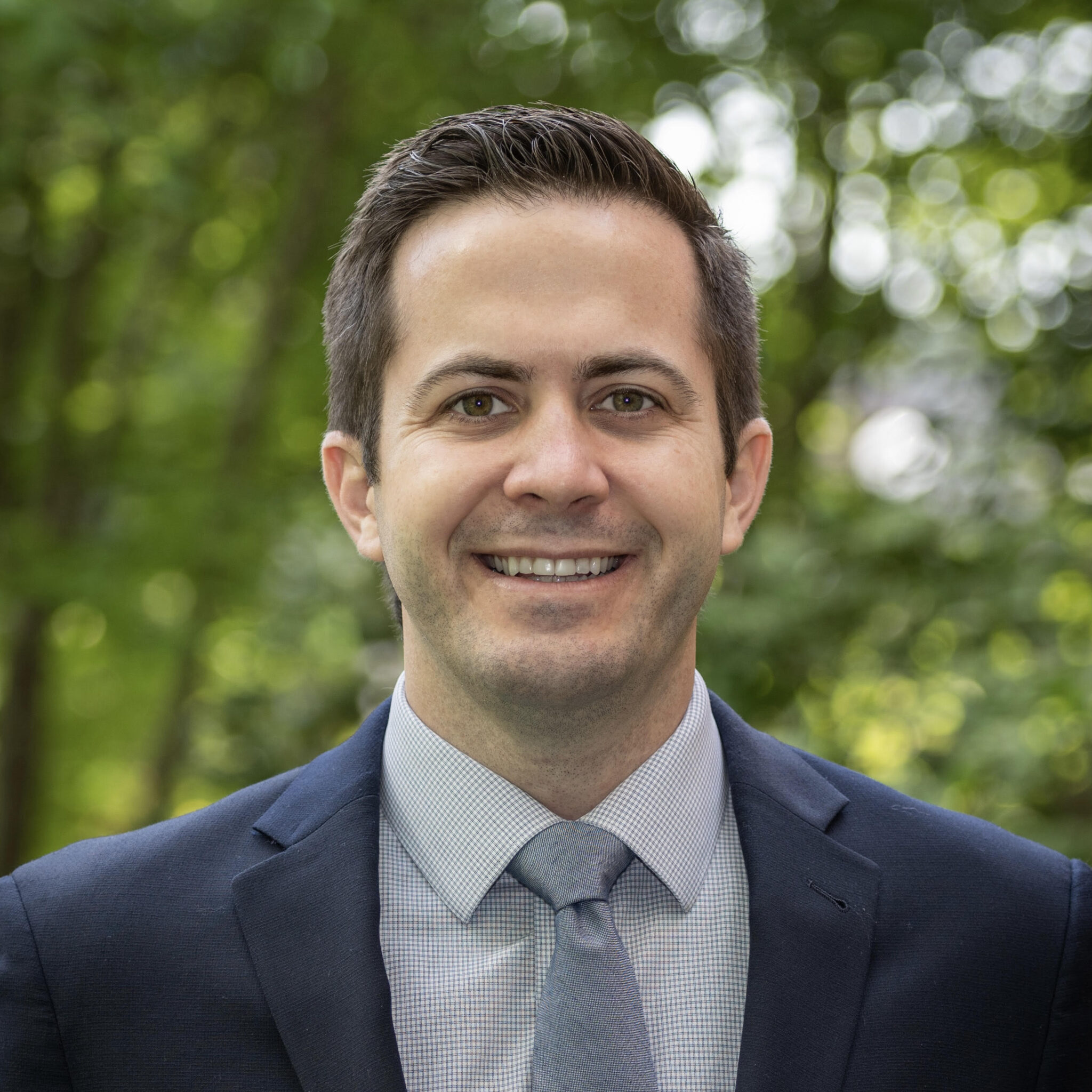
David F. Skanchy, MD is a board-certified ophthalmologist and fellowship-trained pediatric ophthalmologist and adult strabismus specialist at Pediatric Eye Specialists. He completed his residency and pediatric ophthalmology/adult strabismus fellowship at the Kellogg Eye Center at the University of Michigan, where he served as chief resident. A member of the American Academy of Ophthalmology and AAPOS, he treats the full range of pediatric eye conditions and specializes in complex strabismus, amblyopia, pediatric cataracts, and retinopathy of prematurity.