
When your child comes home from school rubbing their forehead or asks to lie down in the middle of the afternoon, it is hard not to worry. Headaches in children are common, and they can have many different causes. For some kids, the source is a vision problem that has gone unnoticed. At Pediatric Eye Specialists, we help North Texas families sort out whether their child’s eyes are part of the picture, so you can get answers and help your child feel better.
Can Vision Problems Really Cause Headaches in Children?
Yes, although eye problems are only one of many possible causes. Headaches in children are often linked to things like poor sleep, dehydration, skipped meals, stress, illness, or migraine. Research suggests that vision is a less common cause than many parents expect, but it is still worth checking, especially when headaches follow certain patterns.
When a child’s eyes do not focus properly, the eye muscles and the brain have to work harder to keep things clear. Over the course of a school day, that extra effort can lead to eye strain, tired eyes, and a dull ache or feeling of pressure around the forehead and temples. Because children rarely know what clear vision is supposed to look like, they may never mention blurred vision at all. Unlike an adult, a child often assumes that everyone sees the world the same way they do.
Which Eye Conditions Are Most Likely to Cause Headaches?
The most common eye-related cause is an uncorrected refractive error, which happens when the shape of the eye prevents light from focusing clearly. There are a few types to know about.
Hyperopia, or farsightedness, makes close-up work, such as reading and homework, harder to keep in focus. Many children compensate by working the focusing muscles inside the eye to adjust the natural lens, but that constant effort is a well-known source of eye strain and headaches.
Astigmatism occurs when the front of the eye is shaped more like a football than a basketball, which can blur vision at every distance. Even a mild amount can leave a child squinting and fatigued by the end of the day.
Myopia, or nearsightedness, makes distant objects such as the whiteboard look fuzzy. Children with myopia often squint to see clearly, which can contribute to headaches.
Problems with how the eyes work together can also play a role. Children with strabismus, a condition in which the eyes are not properly aligned, or with difficulty keeping the eyes coordinated during close work, may have headaches, tired eyes, or occasional double vision. These issues can also affect visual perception, which is how the brain makes sense of what the eyes see.
What Signs and Symptoms Suggest My Child’s Headaches Are Eye-Related?
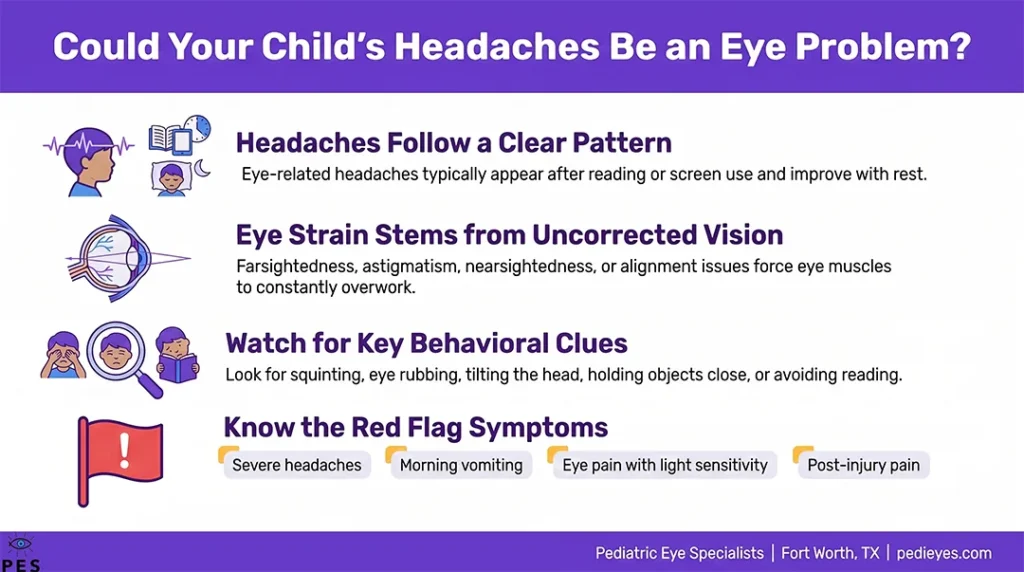
Eye-related headaches tend to follow a pattern. They often show up later in the day or after reading, homework, or screen use, and they usually improve after rest. Your child may also show one or more of these signs:
- Squinting, rubbing their eyes, or tilting their head to see
- Holding books or devices very close to their face
- Complaining of blurred vision or double vision
- Losing their place while reading or avoiding reading altogether
- Closing or covering one eye
- Noticing that one eye seems to drift inward or outward
If your child’s headaches seem tied to long stretches on a tablet or computer, our article on screen time and digital eye strain offers helpful tips for building healthier habits.
When Is a Headache a Sign of Something More Serious?
Most childhood headaches are not dangerous, but some situations call for prompt medical attention. Contact your child’s pediatrician or seek urgent care if any of these apply:
- Headaches are severe or getting steadily worse.
- Headaches wake your child from sleep.
- Headaches come with nausea or vomiting, especially in the morning.
A headache that follows a head or eye injury also needs to be checked right away. So does one that comes with confusion, weakness, or sudden changes in vision.
Some eye-related warning signs deserve quick attention as well:
- Eye pain with redness and sensitivity to light, which can point to inflammation inside the eye such as uveitis
- A noticeable difference in the size of the pupils
- Any sudden loss of vision
Increased pressure inside the eye is rare in children, but it is one of the reasons a thorough exam matters when symptoms do not add up.
Start your child’s journey to better vision today.
Embrace a future of clearer vision and confidence for your child. Contact us now to book your consultation at any of our convenient locations across the Metroplex.
How Is an Eye-Related Headache Diagnosed?
The first step is a comprehensive eye examination with a doctor who specializes in pediatrics. A pediatric eye exam measures visual acuity in each eye, checks eye alignment and focusing, and looks for any signs of eye disease. In most cases, we use dilating drops to widen the pupil. This allows us to examine the health of the retina and optic nerve and to measure your child’s true prescription. Dilation is especially important for detecting farsightedness, since children can often hide it by focusing harder during the exam.
At Pediatric Eye Specialists, our therapeutic optometrists, Dr. Alicia Derry, Dr. Emily Horn, and Dr. Trey Paschal, use age-appropriate testing to make the visit comfortable for children of all ages. If the exam points to a medical concern, our fellowship-trained pediatric ophthalmologists are available within the same practice. Your child can move from routine care to specialized ophthalmology care without an outside referral. If the exam shows healthy eyes, that information is still valuable, since it helps your pediatrician rule out vision as a cause and focus on other possibilities.
Will Glasses Help My Child’s Headaches?
When a refractive error is the cause, glasses are often the simplest and most effective solution. Once the eyes no longer have to strain to focus, many children notice fewer headaches and more comfort during reading and schoolwork. Correcting vision early also matters for long-term eye health, since uncorrected refractive error is one of the most common causes of visual impairment in children.
Pediatric Eye Specialists has an in-house optical shop, so families can choose durable, kid-friendly frames and have each lens fitted properly right after the exam. For children with eye alignment or coordination problems, our doctors will discuss treatment options suited to your child’s specific diagnosis.
Key Takeaways for Parents
- Vision problems are one possible cause of childhood headaches, but not the only one.
- Farsightedness, astigmatism, myopia, and eye alignment problems are the most common eye-related causes.
- Eye-related headaches often appear after reading or close work and improve with rest.
- Severe headaches, morning nausea, eye pain, or headaches after an injury need prompt medical attention.
- A comprehensive eye exam can confirm or rule out vision as the cause.
Is It Time to Schedule Your Child’s Eye Exam?
If your child has frequent headaches and you are wondering whether their eyes could be involved, Pediatric Eye Specialists is here to help you find answers. Our compassionate team of pediatric optometrists and fellowship-trained pediatric ophthalmologists offers advanced eye care for every child, all under one roof. Book your child’s appointment at our Fort Worth, Keller, Mansfield, or Prosper office, or call us at 817-529-9949 to take the first step toward clearer vision and more comfortable days.
Medically Reviewed By:
Michael G. Hunt, MD
Board-Certified Ophthalmologist
Fellowship-Trained Pediatric Ophthalmology and Adult Strabismus
Last reviewed October 15, 2026

David F. Skanchy, MD is a board-certified ophthalmologist and fellowship-trained pediatric ophthalmologist and adult strabismus specialist at Pediatric Eye Specialists. He completed his residency and pediatric ophthalmology/adult strabismus fellowship at the Kellogg Eye Center at the University of Michigan, where he served as chief resident. A member of the American Academy of Ophthalmology and AAPOS, he treats the full range of pediatric eye conditions and specializes in complex strabismus, amblyopia, pediatric cataracts, and retinopathy of prematurity.